EcoPure Learning Center · Water Quality
Microplastics in Drinking Water: What the Science Actually Says
Found in human blood, arterial plaque, and placentas — here is a clear-eyed look at the evidence, and what you can actually do about your tap water today.
How widespread is microplastic contamination in drinking water?
Research consistently finds microplastics in both tap and bottled water worldwide. Studies spanning multiple continents found microplastics in over 80% of water samples tested — with concentrations in tap water ranging from trace levels to over 1,000 particles per liter depending on location and detection method.
of global tap & bottled water samples test positive for microplastics
plastic fragments per liter of bottled water found in 2024 Columbia/Rutgers study
of those fragments were nanoplastics — even smaller and harder to filter
Sources: Agyepong et al., J. Water Sanitation & Hygiene, 2025; Qian et al., PNAS, 2024 (via NIH)
What are nanoplastics, and why are they more dangerous than microplastics?
In January 2024, researchers at Columbia and Rutgers published a landmark paper in PNAS using a new laser imaging technique to count nanoplastics in bottled water for the first time. They found approximately 240,000 fragments per liter — 10 to 100× more than prior estimates — with 90% being nanoplastics (below 1 micrometer in size).
What health effects do microplastics in drinking water cause?
In 2024, the New England Journal of Medicine found microplastics in the arterial plaque of cardiac surgery patients — and those with plastics in their plaque had a significantly higher risk of heart attack, stroke, or death over three years. Peer-reviewed reviews identify four primary mechanisms of harm:
Oxidative stress
Plastic particles generate reactive oxygen species in cells, promoting chronic disease.
Chronic inflammation
Sustained immune responses linked to cardiovascular disease, diabetes, and cancer.
Endocrine disruption
BPA, phthalates, and flame retardants carried by plastics interfere with hormone regulation.
Gut microbiome shifts
Microplastic exposure is associated with microbial changes affecting immune function.
For most outcomes, current evidence shows associations rather than proven causation. The WHO has called for accelerated research.
Does municipal water treatment remove microplastics?
Municipal treatment removes 70–90% of larger microplastic particles, but the smallest particles — including nanoplastics — regularly escape. Microplastics can also re-enter finished water through aging plastic pipes between the treatment plant and your tap. As of 2025, no country has set an enforceable limit on microplastics in drinking water.
Which water filters actually remove microplastics?
Not all filters catch microplastics. Performance is determined by pore size and the specific filter media used. Always look for NSF/ANSI Standard 401 certification — the only independent standard that specifically verifies microplastic reduction — and verify it on a per-product basis.
Pitcher Filter
Optimized for taste & chlorine. Does not reliably remove microplastics. Not rated under NSF 401.
Not rated for MPsCarbon Filtration
Installed under-sink or whole-home systems using carbon media. Reduces chlorine, VOCs, PFAS, and many contaminants. Some certified models carry NSF 401 rating for microplastics — always verify by product.
NSF 401 on select modelsReverse Osmosis (RO)
0.0001 micron membrane. Removes microplastics, PFAS, heavy metals, dissolved solids & more.
NSF 401 certifiedWhat can I do to reduce microplastics in my drinking water?
Should I stop buying bottled water to reduce microplastic exposure?
Yes. Bottles release more microplastics than they prevent. Switch to a stainless steel or glass bottle filled from a filtered tap. This is the single highest-impact, lowest-cost change most households can make.
Does boiling tap water remove microplastics?
It depends on your water hardness. Visit the EPA consumer confidence report tool and enter your zip code. If your water is hard (>120 mg/L calcium carbonate), boiling for five minutes then straining through a coffee filter removes up to 90% of microplastics at zero cost.
Does my current water filter remove microplastics?
Most pitcher filters do not. Search your model in the NSF certified products database and look for Standard 401 coverage and a micron rating of 1 or below. If it isn’t listed, it likely is not removing microplastics.
What is the best water filter for removing microplastics?
A certified reverse osmosis system provides the broadest protection — removing microplastics, PFAS, heavy metals, and dissolved solids. A point-of-use filter at the tap also catches particles that enter from household plumbing after municipal treatment. EcoPure’s ECOP30 RO system is NSF-certified and designed for easy DIY installation.
What is the best water filter for renters who can’t modify plumbing?
You don’t need to own your home to get serious filtration. EcoPure’s EPWPFF connects directly to your existing cold-water line under the sink — no new faucet, no permanent modifications, no tools required.
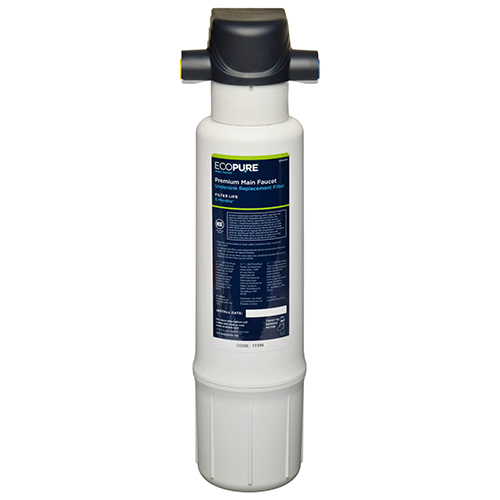
EcoPure EPWPFF — Premium Main Faucet Filtration System
Attaches to your existing faucet’s cold-water line. No drilling, no dedicated faucet, no landlord approval needed. Certified to reduce PFAS, lead, cysts, pharmaceuticals, chlorine, and sediment. Filter replacement takes seconds — no tools, no mess, no water shutoff. 6-month filter life.
View the EPWPFF →Not sure what’s in your water?
Get a free EcoPure test strip — and find the right filter for your home.
The science on microplastics is evolving rapidly. Evidence is strong enough to warrant precautionary action — the clearest takeaway being that bottled water is not the answer, and certified point-of-use filtration is the most reliable protection available today.