What do those NSF numbers on your water filter actually mean?
You’ve seen “NSF certified” on filter packaging. But 42, 53, 58, 401, 372 — what’s the difference, and why does it matter more than “8-stage filtration”? Here’s the plain-English guide.
When you’re shopping for a water filter, you’ll see two kinds of claims. The first kind: “8-stage filtration,” “advanced purification,” “removes 99% of contaminants.” These are marketing claims — written by the manufacturer, tested by nobody, and not required to prove anything. The second kind is an NSF certification number. That’s something different entirely.
NSF International is an independent, not-for-profit public health organization founded in 1944. [1] When a filter earns an NSF certification, it means an independent laboratory has physically tested that product and confirmed it does what the manufacturer claims — under standardized conditions, across the full rated life of the filter, with results publicly verifiable by anyone. [2]
There are five NSF standards every filter buyer should know. Each one tests for something different.
The Five NSF Standards
Filtration performance standards
Emerging contaminants & materials safety
Why “8-Stage Filtration” Doesn’t Mean What You Think
A “stage” is just a marketing word with no regulated definition. Manufacturers can count them however they like — a second carbon filter, an alkaline mineral layer, a UV bulb, even a mesh screen can each count as a “stage.” [6] More stages doesn’t mean cleaner water. It means a longer number on the box.
What actually determines whether a filter removes a contaminant is the type of media inside it, how long water spends in contact with it, and the flow rate — not how many times it counts that process as a separate step. A well-designed 3-stage system with NSF 53 certification will outperform a 9-stage filter with no certification every single time.
What to Know Before You Buy
- A product certified to a standard may not cover every contaminant — only the ones it was individually tested for. Always check the specific contaminant list, not just the standard number. [8]
- A filter might be NSF 58 certified for arsenic, but not radium. Match the certification to what’s in your water.
- Verify any product’s certification for free at listings.nsf.org. [9]
- “Tested to NSF standards” or “tested in a certified lab” do not mean NSF certified. The manufacturer may have run their own internal tests with no independent oversight. [10]
- Always look for the actual NSF certification mark with the standard number, from NSF, WQA, or IAPMO — the only three authorized certifying bodies.
- “NSF certified” alone tells you nothing without the standard number. NSF 42 covers taste and odor only — not lead or health contaminants.
How to Shop Using This Guide
Know what you’re worried about, then match it to the right standard. Most people start here — if you want to go further and see exactly what’s measured in your local supply, there’s a way to do that too.
Most households will benefit from more than one of these. A filter carrying NSF 42 + 53 + 372 is a strong baseline for city water. An RO system with NSF 42 + 58 + 372 provides the broadest protection for most homes.
Your local utility is required to publish an annual water quality report — search your city name plus “water quality report” or visit EWG’s Tap Water Database to find yours. If you’re on well water, or want a more detailed picture than the utility report provides, an at-home test kit or a certified lab test will tell you exactly what you’re dealing with.
Once you have your results, use the checklist above to match what you found to the right certifications. Instead of making your best guess, you’ll know precisely which contaminants to target — and can verify that the filter you choose is specifically certified to reduce them.
Search the exact model number at listings.nsf.org before purchasing. If it’s not listed, the certification claim isn’t real — regardless of what the packaging says. [9]
Every filter we recommend carries at minimum NSF 42 and NSF 372 certification. For RO systems, we require NSF 58. We prioritize products that also carry NSF 53 and NSF 401 — because what’s verified is what protects you, not what’s claimed.
- 1NSF International — Official History (founded 1944, University of Michigan)
- 2NSF International — Standards for Water Treatment Systems
- 3ANSI Blog — NSF/ANSI 58-2022: Reverse Osmosis for Drinking Water
- 4NSF International — Emerging Contaminants / NSF 401
- 5Water & Wastes Digest — NSF/ANSI/CAN 372 Low-Lead Certification
- 6WaterAnywhere — The 5 Stages of a Home RO System
- 7TapWaterData — Understanding NSF Water Filter Certifications
- 8Tap Score — NSF/ANSI Certifications Explained
- 9NSF International — Certified Products and Systems Database
- 10US Water Advisor — NSF Certification Explained
Each of these EcoPure systems carries the NSF certifications that matter. Choose based on how your water is delivered to your glass.
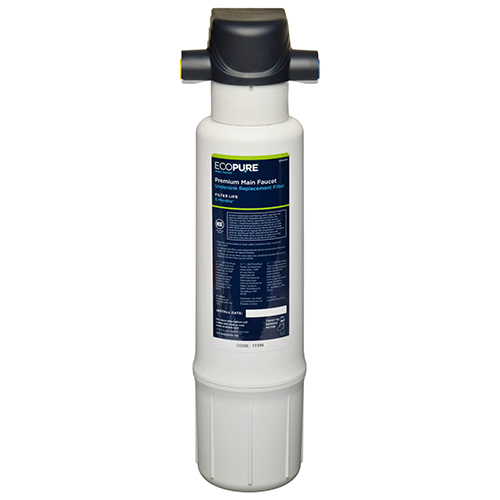
Connects under your sink and delivers filtered water directly through your existing faucet — no separate tap needed. The no-fuss entry point to certified filtration.
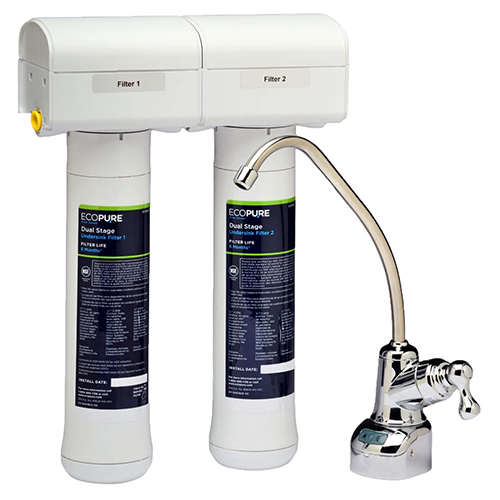
A space-saving under-sink system with dedicated filtered water tap. Two-stage certified filtration that reduces lead, chlorine, and a broad range of health contaminants.
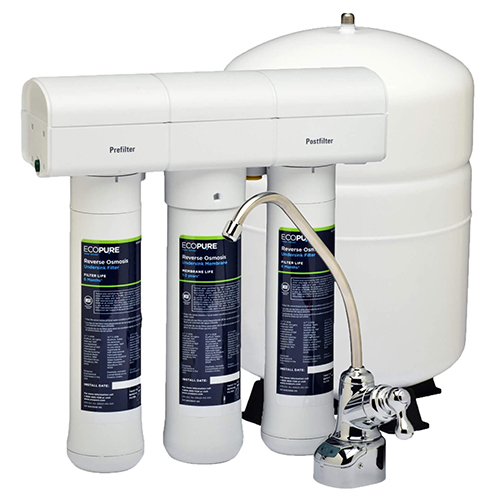
Bottled-water quality from your tap. Full reverse osmosis certified to NSF 58 for the broadest contaminant removal — including TDS, lead, arsenic, fluoride, and nitrates.