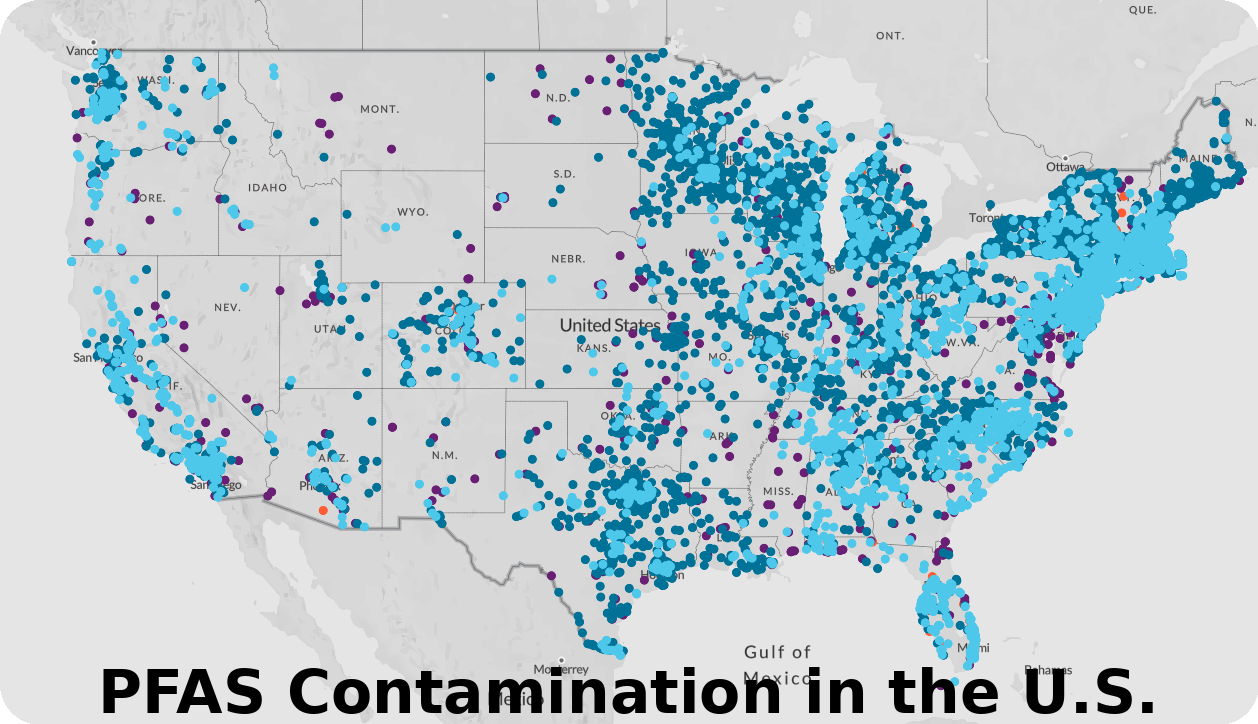
What Are PFAS and Why People Are Paying Attention
PFAS (per- and polyfluoroalkyl substances) are often called “forever chemicals” because they do not break down over time.
They have been used for decades in products designed to resist heat, water, and oil. Things like cookware, food packaging, and stain-resistant materials. Today, they are showing up more often in drinking water across the U.S.
For most households, tap water is one of the most consistent ways exposure can happen.
Source: EPA – Reducing PFAS in Your Drinking Water with a Home Filter
Why PFAS Have Become a Priority
What makes PFAS different is persistence.
They do not simply pass through your system. They can build up over time. Even small amounts, when consumed daily, become more meaningful.
That is why the EPA and other organizations have tightened guidance. It is also why more homeowners are taking a closer look at their water instead of assuming it is fine.
For families who want confidence in what they are drinking, this is becoming something to solve.
Source: EPA – Health and Environmental Risks from PFAS
Why PFAS Are Difficult to Remove
PFAS were engineered to be extremely durable. That durability is what makes them hard to filter out.
Many basic filtration systems are not designed to handle these contaminants. If PFAS is your concern, the type of system you choose matters more than anything else.
Source: ITRC – PFAS Treatment Technologies
What Actually Works
Reverse Osmosis (RO)
Reverse osmosis is widely recognized as one of the most effective methods for reducing PFAS.
It works by pushing water through a membrane that removes contaminants at a very fine level, including dissolved PFAS.
Source: EPA – Identifying Filters Certified to Reduce PFAS
- Best for: Homeowners who want the highest level of protection
- Families focused on long-term water quality
Advanced Carbon Filtration
High-quality carbon filtration can also reduce PFAS when properly designed and maintained.
The key is not just having a carbon filter, but having one that is certified for this purpose.
Source: EPA – PFAS Treatment Technologies
- Best for: Simpler upgrades
- Faster installation
- Renters or non-permanent setups
Ion Exchange
Ion exchange is used in some systems to target specific contaminants, including PFAS.
Source: ITRC – PFAS Treatment Technologies
What to Look For in a PFAS Filter
Look for NSF Certification
Start by checking whether the system is certified to the NSF/ANSI 53 or 58 standards. This means the system has been independently tested to reduce specific contaminants.
Make Sure PFAS Is Included
Check that the certification specifically includes:
- PFOA reduction
- PFOS reduction
Source: Penn State Extension – PFAS Water Treatment
A Practical Way to Reduce PFAS at Home
For most households, the best place to focus is the water you drink and cook with.
- Target the highest-impact use
- Improve both safety and taste
- Keep the solution simple
Source: EWG – PFAS in Drinking Water
Where to Start
If your goal is the highest level of drinking water protection, reverse osmosis systems like the EcoPure ECOP30 are built for that.
If you prefer a simpler upgrade, carbon systems like the EcoPure EPWPFF offer certified performance in a more straightforward setup.
- Choose reverse osmosis for the most comprehensive protection
- Choose carbon filtration for a faster, simpler upgrade